Asset data in operation: Which data does each process need?
“Let’s capture everything first, then we’ll see.”
Translation: we don’t know what we need it for.
That sounds harsher than it is meant. The sentence is rarely said out of carelessness. It is said because the question before it was never asked, and because nobody likes to admit they can’t answer it.
Because the order is actually the other way round:
The data doesn’t define the process. The process defines which data you need in the first place.
§ 01In operation
Data lives – or it goes stale.
Every asset in a building is a data record. Maintenance, faults, investment planning and compliance records all run on it. If it is missing or wrong, operations run on assumptions.
§ 02The processes
What happens to the data in operation.
In building operations, as I see it, six processes draw on the same building and asset data record:
Planning maintenance
“What needs servicing this week – and by whom?”
Asset × interval gives you the maintenance plan. The CAFM system generates the work orders from it – no asset list, no plan.
StandardDIN 31051: servicing, inspection, repair, improvement.
Fault & ticket
“Ventilation on the 3rd floor has failed: which asset? Who is responsible?”
The report is booked straight onto the asset via QR code. The technician arrives knowing the type, the history and the spare part.
In practiceEvery ticket adds to the history – the basis for “repair or replace”.
Lifecycle & CAPEX
“What is due in the next 10 years – and what will it cost?”
Year of construction plus service life gives the replacement year; the condition on site corrects it. That is how the investment plan comes together.
ExampleHeat pump, built 2008, service life 20 yrs5 – budget for replacement in 2028.
Operator responsibility
“Is there proof that the fire alarm system was inspected on time?”
Assets subject to inspection, deadlines and reports are attached to the record. Gaps show up before something happens.
LawArt. 58 CO: liability for defective maintenance – even without fault.4
Tender & switch
“What exactly should the new FM service provider look after?”
The asset list is the bill of quantities for the tender. If it is wrong, every bidder calculates wrong.
In practiceErrors only show after the contract is awarded – as a variation order or a gap.
Energy & ESG
“Where are we using too much – and which assets still heat with fossil fuels?”
Energy source, output and operating hours per asset show where optimisation or replacement pays off most.
FigureEnergy-focused operational optimisation typically saves 10–15 % of energy.6
Each of them needs something different.
§ 03The data
One data record – six processes draw on it.
For maintenance planning, the intervals are decisive and the year of construction is secondary. For the investment plan it is exactly the other way round. For the tender, what counts is that the list is complete, less how deep it goes. And for proof to the owner, only one thing counts in the end: whether the inspection report is attached to the right record.
| Data field | 01Maintenance | 02Faults | 03Lifecycle | 04Compliance | 05Tender | 06Energy |
|---|---|---|---|---|---|---|
| Asset ID / QR code | ||||||
| Location (floor, room) | ||||||
| Asset type & classification | ||||||
| Manufacturer, model, serial number | ||||||
| Year built & condition | ||||||
| Maintenance & inspection intervals | ||||||
| Documents & reports | ||||||
| Energy source & output |
Only a handful of fields are essential across all six processes. Everything else depends on what you are planning to do.
§ 04Getting started
Hence the question that comes before any data capture:
Which of these six processes is the trigger?
Starting there is cheaper and faster than doing everything at once. And you notice after 2-3 weeks whether it works, instead of finding out after two years that nobody has touched the data.

Where does the data come from? Mostly from PDFs, Excel lists and people’s heads. flint reads existing documents; a smartphone video of the walkthrough confirms and completes them.
- 1Read documentsAsset lists, contracts, plans
- 2Film the buildingwith a smartphone
- 3Check & send to CAFMeBKP-H, BKP or DIN 276
All the information on one page: download our factsheet as a PDF.
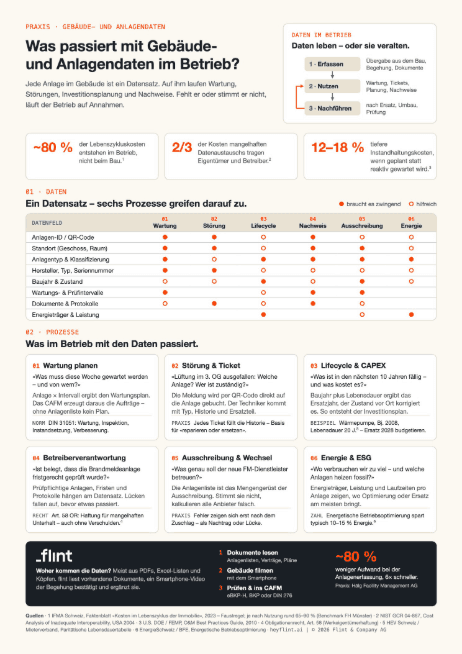
What happens to building and asset data in operation?
Because we hear exactly these questions again and again, we have summarised it on one page: which processes draw on the data, which fields each of them needs, and what happens when they are missing.
Download PDFSources
- IFMA Switzerland, fact sheet “Kosten im Lebenszyklus der Immobilie”, 2023 – rule of thumb; roughly 65–90 % depending on use (FH Münster benchmark)
- NIST GCR 04-867, Cost Analysis of Inadequate Interoperability, USA 2004
- U.S. DOE / FEMP, O&M Best Practices Guide, 2010
- Swiss Code of Obligations, Art. 58 (liability of owners of buildings and structures)
- HEV Schweiz / Swiss Tenants’ Association, joint service-life table
- SwissEnergy / SFOE, energy-focused operational optimisation